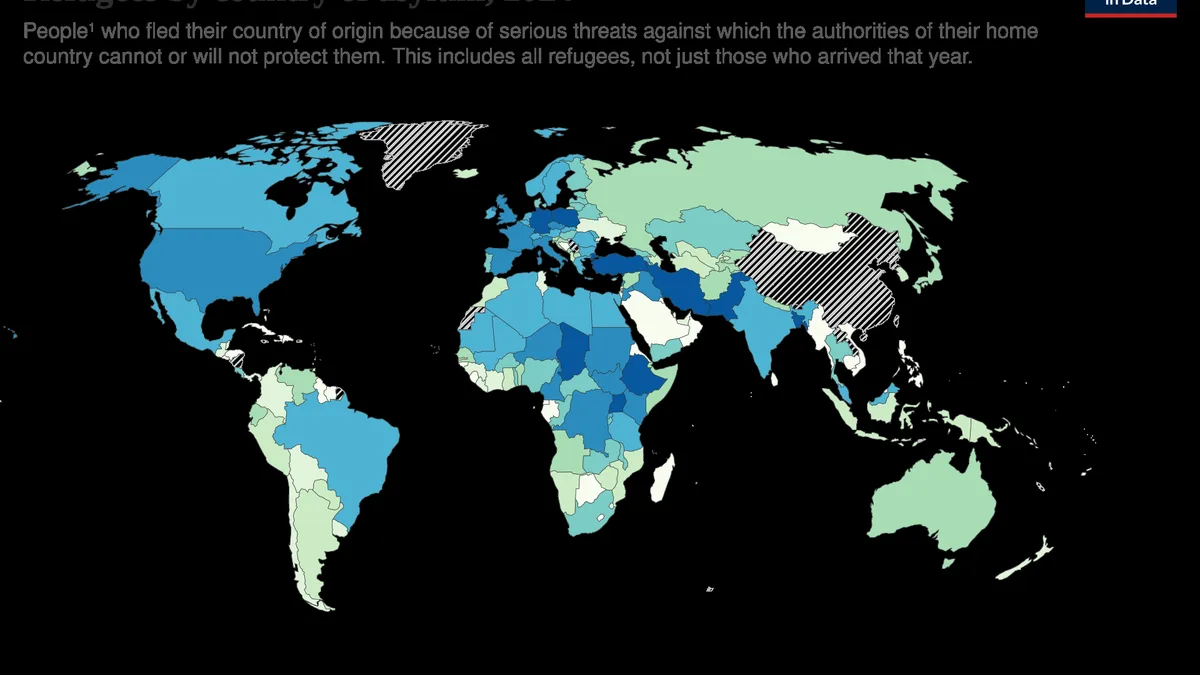
Refugee
| Visa category | Refugee status |
|---|---|
| Queue behind it | Asylum application process |
| Policy change that moved it | Refugee Act of 1980 (U.S.) |
| Country of origin | Varies by applicant |
| First created | Mid-20th century (post-WWII international frameworks) |
| Original use | Protection for individuals fleeing persecution |
| Path to permanence | Adjustment of Status to Lawful Permanent Resident |
| Annual cap | Set by Presidential determination |
Origin and history
The legal concept of refugee status originates from international responses to population displacements in Europe during the early and mid-20th century. Its modern definition was formally codified in the 1951 United Nations Convention Relating to the Status of Refugees, established in the aftermath of World War II. The Convention was originally geographically limited to events occurring in Europe before 1951. The 1967 Protocol removed these temporal and geographic restrictions, making the definition globally applicable. This framework establishes the principle of non-refoulement, prohibiting the return of a refugee to a territory where their life or freedom would be threatened. The international system has since been supplemented by regional agreements, such as the 1969 OAU Convention in Africa, which expanded the definition to include those fleeing generalized violence.
What it is for
Refugee status is a form of international protection for individuals who are outside their country of nationality and are unable or unwilling to return due to a well-founded fear of persecution. This persecution must be based on one of five grounds: race, religion, nationality, membership of a particular social group, or political opinion. The status is not intended for individuals fleeing general hardship, poverty, or natural disasters unless linked to one of the five grounds. Its primary purpose is to provide a safe haven and a legal alternative to removal for those at risk. Once recognized, refugees are typically granted the right to remain in the host country and may receive access to certain social services. The status is fundamentally a surrogate for the protection the individual's own government has failed or refused to provide.
How to renew Refugee
Refugee status itself is not typically "renewed" in a periodic manner like a visa; it is a continuous status until it ceases for specific reasons. The documentation proving status, such as a refugee travel document or residence permit, will have an expiration date and must be renewed through the host country's immigration authority. To renew this documentation, the holder must usually prove their underlying refugee status remains valid, meaning conditions in their home country have not fundamentally changed. This often involves submitting a formal application before the current document expires, along with updated photographs and any required fees. The process requires demonstrating continued eligibility, as cessation clauses may apply if the refugee has voluntarily re-availed themselves of their home country's protection. Failure to renew the travel document on time can complicate international travel but does not automatically invalidate the refugee status.
Refugee requirements
The core requirement is demonstrating a well-founded fear of persecution based on race, religion, nationality, political opinion, or membership in a particular social group. The applicant must be outside their country of nationality, or if stateless, outside their country of habitual residence. The fear of persecution must be subjectively genuine and objectively reasonable, assessed through credible testimony and supporting evidence. The persecution must be perpetrated or condoned by state authorities, or by non-state actors the state is unwilling or unable to control. The applicant must show they are unable or unwilling to seek the protection of their home country due to this fear. Mere personal dislike, general violence, or economic hardship are insufficient grounds without a nexus to one of the five protected categories.
Refugee processing time
Processing times for refugee status determination vary drastically depending on the host country's system, resources, and the volume of applications. In many national systems, there is a significant administrative queue, leading to waits that can extend for several years from initial application to a final decision. The complexity of individual cases, the need for interviews, and the availability of country-of-origin information all influence the timeline. Some systems have expedited procedures for manifestly well-founded or clearly unfounded claims, while others treat all claims through a standard, lengthy process. Appeals and judicial reviews following an initial denial can add years to the overall processing period. The uncertainty during this prolonged processing time, often with limited work rights and in temporary accommodation, is a major challenge for applicants.
Pros and cons
A primary pro is the grant of permanent protection and a pathway to eventual permanent residence and citizenship in many host countries, offering a durable solution. It provides legal status, work rights, and access to essential services like education and healthcare, enabling rebuilding of life. A significant con is the often protracted and psychologically taxing determination process, marked by uncertainty and restrictive temporary conditions. Refugees frequently face prolonged family separation, as family reunification processes are slow and complex. A common regret stems from the near-impossibility of safe return to the home country, even for visits, creating a permanent state of exile. The status can also carry social stigma in some host communities, impacting integration. A common mistake is conflating refugee status with other humanitarian protections, leading to applications under the wrong category and subsequent refusal.
Who it suits
This status suits individuals who have no viable option for safe return to their country of origin due to a targeted threat, making it a last resort. It is appropriate for those who can credibly articulate and document a specific fear of persecution tied to their identity or beliefs, as opposed to a generalized danger. It suits individuals prepared for a lengthy legal process and the challenges of integrating into a new society, often without an existing diaspora community for immediate support. It is less suited for those seeking a temporary haven with the intention of returning home quickly once conditions improve, as the status implies a more permanent dislocation. It is also ill-suited for individuals whose primary motive is economic advancement without a core protection need, as such applications are routinely rejected under the established criteria.
Latest Refugee news
Latest reporting
U.S. Commits $268.9 Billion to Deportation Through 2029
The Trump administration has backed $268.9 billion for immigration enforcement through fiscal year 2029, while refugee admissions narrowed sharply to

Green Card delays block SNAP for refugees
San Antonio refugee families are being denied SNAP food benefits due to prolonged green card processing delays, advocates report.