H 1B
| Country of origin | United States |
|---|---|
| First created | 1990 |
| Original use | To allow U.S. employers to temporarily employ foreign workers in specialty occupations |
| Visa category | Non-immigrant, employment-based |
| Typical duration | Up to three years, extendable to six years |
| Dependency | Requires a sponsoring U.S. employer |
| Annual cap | Subject to a statutory numerical limit |
| Prevailing wage | Must meet or exceed the prevailing wage for the occupation and area |
Origin and history
The H-1B visa category originates from the United States immigration system. It was created by the Immigration Act of 1990, which overhauled the existing framework for employment-based immigration. The visa replaced and expanded upon the older H-1 visa, which had a more limited scope and duration. Its legislative creation was a response to growing demand for highly skilled foreign workers in specialized fields, particularly in technology and engineering. The category was designed as a temporary, non-immigrant visa to address specific labor shortages without providing a direct path to permanent residence. The fundamental structure, including the annual numerical cap and the labor condition application requirement, was established at its inception in the early 1990s.
What it is for
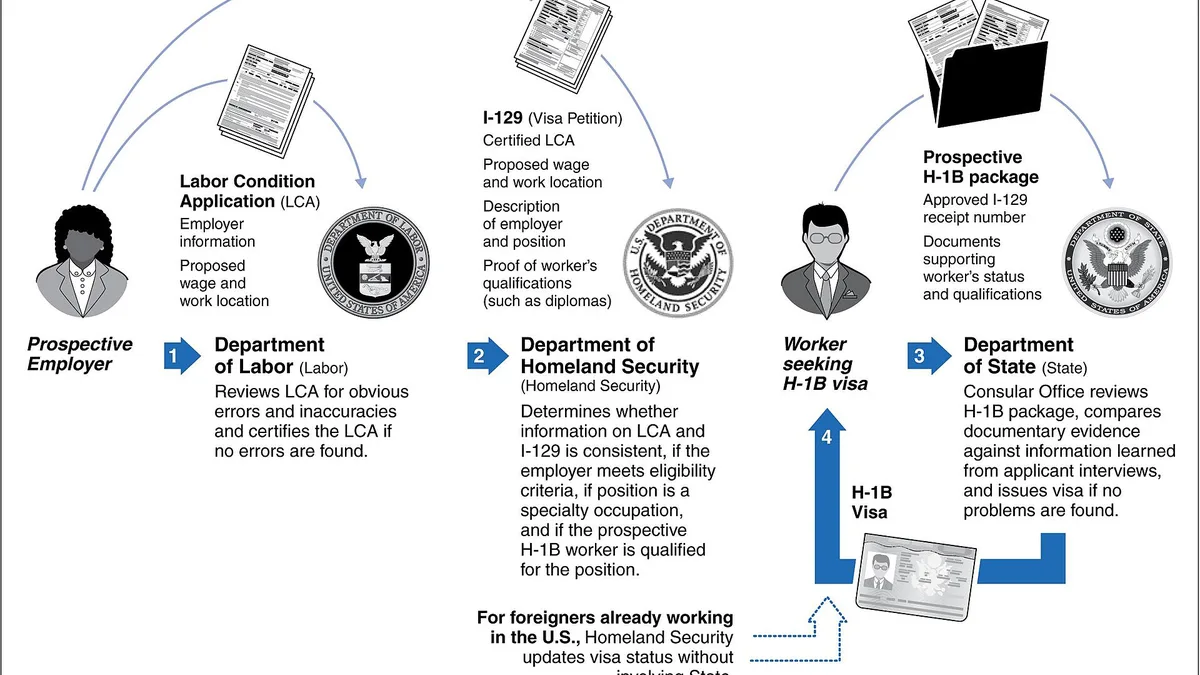
The H-1B visa is for United States employers to temporarily hire foreign nationals in specialty occupations. A specialty occupation is defined as one that requires the application of highly specialized knowledge and a bachelor’s degree or higher in a specific field, or its equivalent. Common fields for H-1B workers include computer science, mathematics, engineering, finance, and medicine. The visa is strictly employer-specific, meaning the holder is authorized to work only for the sponsoring employer and in the specific role and location detailed in the petition. It is not an immigrant visa, but it is considered "dual intent," allowing holders to pursue lawful permanent resident status concurrently. The primary purpose is to allow U.S. companies to fill positions for which they cannot find a sufficient supply of qualified and available U.S. workers.
Pros and cons
A significant advantage is that it allows skilled professionals access to the U.S. job market and valuable career experience with leading global companies. The dual-intent doctrine permits holders to simultaneously pursue green cards, which is a major benefit for those seeking permanent residency. However, a major drawback is the visa's strict employer dependence, leaving holders vulnerable if they lose their job, as they have only a 60-day grace period to find new sponsorship or depart. The lottery system introduces immense uncertainty, with many qualified candidates and employers failing to be selected each year despite significant investment of time and money. Holders often regret the lengthy and restrictive path to permanent residency, which can keep them in a state of professional limbo for many years, tied to a single employer for sponsorship. A common mistake is underestimating the portability rules when changing jobs, which require a new approved petition before starting the new role, creating risky gaps in employment authorization.
Who it suits
This visa suits foreign professionals with at least a bachelor's degree in a field like technology, engineering, or finance who have received a job offer from a U.S. employer for a specialized role. It is appropriate for individuals seeking temporary, career-advancing work experience in the United States without an immediate commitment to immigrate permanently. It also suits those who are patient with bureaucratic processes and can tolerate the uncertainty of the annual lottery and lengthy processing timelines. The visa is a practical choice for employees of cap-exempt organizations like universities and research institutions, as they avoid the lottery. It is less suitable for entrepreneurs or those wishing to work independently, as the visa mandates a strict employer-employee relationship. Ultimately, it best serves individuals whose long-term goal aligns with their sponsoring employer's willingness to eventually support a permanent residency application.